Prepping for Beginners: A Calm 30-Day Plan
New to prepping? Start with a calm 30-day plan: water, food, light, heat, meds and paperwork, built around a $50-a-week budget and a printable checklist.
BLUF Bottom line up front
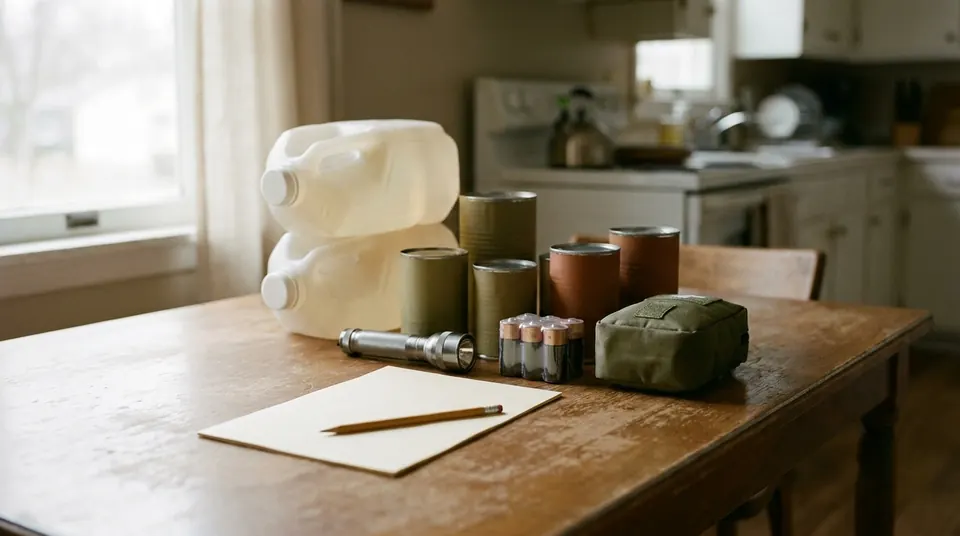
Prepping for beginners starts with the boring basics: water (1 gallon per person per day), food you already eat, light, heat, medicines and a family plan. Build a 3-day supply first, then 2 weeks. Spend about $50 a week, buy nothing tactical, and finish the core in 30 days.
- Start with water, food you already eat, light, heat, medicines, documents and a family plan. In that order.
- Ready.gov says one gallon of water per person per day for several days. Many agencies now suggest working toward 2 weeks.
- About $50 a week is enough to cover the core in a month. Gear comes last.
- Store what you eat and eat what you store, so nothing rots in a closet.
- Most emergencies are power cuts, storms and outages, not movie disasters. Prepare for those.
If you are searching for prepping for beginners, you probably want one thing: where do I start without buying a bunker. Start with a bucket of water, a few extra cans, a flashlight and a plan for who calls whom.
That is most of it. The realistic emergency is a three-day power cut after an ice storm, a boil-water notice, or a week when the shelves are bare. Nothing cinematic. Cold house, warm fridge, dead phone.
This page is a 30-day plan for that. One small job at a time, cheapest first. You can finish it in a month, and a printable checklist sits near the end.
Prepping for beginners: the short version
Do these, in this order:
- Water. One gallon per person per day. Start with 3 days.
- Food you already eat. Shelf-stable, no cooking or little cooking.
- Light and power. Flashlights, batteries, a charged power bank.
- Heat or cooling. A plan for the coldest or hottest day you can reasonably expect.
- Medicine and first aid.
- Documents and cash.
- A family plan. Who calls whom, and where you meet.
Gear, guns and gas masks are not on the list. We get to that below.
Why most prepping is boring (and why that is the point)
The loudest prepping content is about collapse. The useful stuff is about Tuesday. A burst pipe. A hurricane warning with a three-day evacuation window. A storm that takes out power for a week.
Boring preparation works because it covers the likely events and, as a side effect, most of the unlikely ones. If you can live in your house for two weeks with no power and no running water, you are ready for a surprising range of bad days.
It is also cheap. You are mostly buying groceries early.
The order that matters: the rule of 3s
There is an old survival rule of thumb, not a law: roughly 3 minutes without air, 3 hours exposed to harsh weather, 3 days without water, 3 weeks without food. The exact numbers vary with age, health and conditions. The ranking is what helps.
So the order is shelter and warmth, then water, then food. That is why this plan starts with water and heat before it ever gets to a pantry. Food feels urgent. It is the last thing that kills you.
How much is enough: 72 hours, 2 weeks, 3 months
Pick a target and grow into it.
| Stage | Goal | What it covers |
|---|---|---|
| Stage 1 | 3 days | A storm, a short outage, a boil-water notice |
| Stage 2 | 2 weeks | A long outage, a hurricane aftermath, supply-chain gaps |
| Stage 3 | 1-3 months | Job loss, illness, a rough winter. Mostly rotating pantry food |
Ready.gov’s kit guidance says “several days” of water and food, and it does not name a number beyond that. Some state and local emergency agencies now push 2 weeks as the home target. The sensible reading is: 3 days is the floor, 2 weeks is the goal, and anything past that is a bonus you build slowly.
Stage 3 is not a separate shopping trip. It is your normal pantry, kept deeper.
The 30-day prepping checklist, week by week
Each week has a theme and a small number of jobs. If a week slips, nothing breaks. Pick it up the next weekend.
Week 1: water and light
- Day 1. Count the people and pets in your home. Multiply by 14 gallons each. That is your 2-week water number. A family of four needs 56 gallons.
- Days 2-4. Buy bottled water or fill clean containers. Ready.gov says store at least one gallon per person per day for several days, for drinking and sanitation. It adds that water you bottle yourself should be replaced every six months. Sealed commercial water stays in its original container, in a cool, dark place.
- Day 5. Find your main water shutoff and learn how to close it.
- Days 6-7. Put one flashlight per person where you can find it in the dark. Add spare batteries. Add a power bank, charged. Our power outage checklist has the full list.
For quantities and containers, see how much water to store. A gallon of water weighs about 8.3 lb (3.8 kg), so plan where 56 gallons will live before you buy it.
Week 2: food you already eat
- Day 8. Write down seven dinners your household actually eats that can be made from shelf-stable ingredients. Chili, pasta with jar sauce, rice and beans, tuna melts.
- Days 9-12. Buy two extra of each ingredient, every shopping trip. Do not do one giant haul.
- Day 13. Add a manual can opener. Two is better. Electric ones die with the power.
- Day 14. Plan one way to cook without power, used outdoors only. A camp stove or grill, with fuel.
Cooking indoors with camp stoves or charcoal is a carbon monoxide risk, and Ready.gov is blunt about it: camp stoves and charcoal grills belong outdoors, away from windows. Never use a gas stove or oven to heat the house either.
A full two-week plan, with quantities and a sample menu, is in our 2-week emergency food supply list. The emergency supply calculator does the maths for your household.
Week 3: heat, medicine and first aid
- Day 15. Decide what you will do on the coldest day of the year with no power. Pick one small room. Gather sleeping bags or extra blankets. See how to stay warm without power.
- Day 16. Buy a battery-powered carbon monoxide alarm, or check the batteries on the ones you have. Ready.gov recommends battery-backup CO detectors on every level of the home.
- Day 17. Build a first aid kit, or buy a decent one and add what your household uses.
- Days 18-19. List every prescription, who takes it, the dose and the pharmacy. Ask your doctor or pharmacist whether an early refill or a longer supply is possible. Insurance rules vary, so do not assume.
- Day 20. Add over-the-counter basics: pain reliever, anti-diarrheal, antacid. These are on Ready.gov’s kit list.
- Day 21. If anyone uses a power-dependent medical device or refrigerated medicine, make a plan with their provider. Contact your utility about medical-priority registration.
Week 4: paper, cash and the plan
- Day 22. Photograph or scan IDs, insurance policies, the lease or mortgage, and medical records. Ready.gov suggests keeping copies in a waterproof, portable container, or stored electronically.
- Day 23. Pull out some cash in small bills. Card readers fail when power or networks do. How much is your call. Start with enough for a few days of basics.
- Day 24. Fill the gas tank when it falls below half. Make it a habit.
- Days 25-27. Write the family plan (details below).
- Day 28. Walk through it with everyone in the house.
- Days 29-30. Put the date on your calendar to recheck the kit in 6 months. Ready.gov says to rethink your needs every year.
Prepping for beginners on a budget
You do not need to spend $1,000 in a weekend. A steady $50 a week is our suggested pace. It is our rule of thumb for this plan, not an official figure, and prices differ by region.
| Week | Rough spend | Buy |
|---|---|---|
| 1 | $50 | Water containers or bottled water, flashlights, batteries, power bank |
| 2 | $50 | Extra shelf-stable groceries, two can openers |
| 3 | $50 | CO alarm, first aid kit, OTC medicines |
| 4 | $50 | Blankets or sleeping bag, document folder, small bills |
Ways to spend less:
- Fill food-grade containers with tap water, and sanitize them first. Ready.gov explains how, using dish soap and a diluted unscented bleach solution.
- Buy what you already eat on sale. Do not buy “emergency food” at a premium.
- Skip the kits. A pre-built kit is usually the most expensive way to get the same stuff.
- If money is very tight, buy one extra can per trip and nothing else. Our guide to emergency preparedness on a budget starts with the free steps and scales from there.
What not to buy first
- Tactical gear. Plate carriers and camo are a hobby, not preparation.
- Freeze-dried buckets. They are fine later. They are bad first purchases: expensive, and you will not eat them until you must.
- A generator. Valuable, but it brings fuel, noise and carbon monoxide risk. Do the basics first. When you are ready, read off-grid power options, or compare a portable power station vs a generator.
- Huge fuel stockpiles. Dangerous to store at home in bulk.
- Anything you do not know how to use. A water filter you have never opened is a paperweight.
Store what you eat, eat what you store
This is the one prepping slogan worth keeping. Stock foods your family already likes. Rotate them into normal meals. Buy new ones to replace them.
Food you hate will go uneaten in an emergency too, and morale is a real part of a long outage. If you want longer shelf life, foods that never expire covers the staples that last years. For ideas on what else is worth having in the house, see what to stockpile.
Keep canned food in a cool, dry place. Ready.gov says boxed food should go in tightly closed plastic or metal containers.
The family plan and meeting point
Ready.gov’s family plan is four steps: talk, assess everyone’s needs, write it down, practice. Discuss how you will get alerts, where you will shelter, your evacuation route, how you will communicate, and whether your kit needs updating.
It also says to pick a family meeting place that is familiar and easy to find. We suggest two: one near the house, one in the neighborhood.
Write down:
- Phone numbers on paper, not only in phones. Include an out-of-area contact everyone can reach.
- Where the shutoffs are: water, gas, electric.
- Needs that change the plan: infants, pets, mobility issues, medications.
- Who checks on the elderly neighbor.
Practice once. It takes 20 minutes and finds every gap.
Printable prepping checklist for beginners
Hit Print and tick things off.
Water and light
- 1 gallon per person per day stored (start with 3 days, build to 14)
- Water replaced every 6 months if you bottled it yourself
- Flashlight for every person
- Spare batteries
- Charged power bank and charging cables
- Battery or hand-crank radio
Food
- 7 shelf-stable dinners your household eats
- Two manual can openers
- Outdoor way to cook, with fuel
- Pet food and extra water for pets
Heat and safety
- Warm blankets or a sleeping bag per person
- Battery-backup CO alarm on every level
- Fire extinguisher
- Plan for one warm room
Health
- First aid kit
- Prescription list and a refill plan
- OTC pain, stomach and allergy medicines
- Glasses or contact lens supplies
Paper and money
- Copies of IDs, insurance, bank and medical records
- Cash in small bills
- Printed contact list
Family plan
- Two meeting places chosen
- Out-of-area contact chosen
- Shutoffs located
- Plan practiced once
What to do this weekend
You do not need to start all of it. Do these four things:
- Buy 3 days of water for everyone, including pets.
- Check your flashlight batteries and CO alarm.
- Photograph your ID, insurance and prescriptions.
- Put “recheck kit” on your calendar six months from now.
That already puts you ahead of most households.
Frequently asked questions
How do I start prepping with no money?
Use what you already own. Fill clean containers with tap water, put flashlights in one place, photograph your important documents, write the family plan and list your prescriptions. All free. Then add one extra can or one gallon of water per shopping trip. A few dollars a week adds up faster than people expect, and a dollar store prepping list shows where the cheap basics are.
How long should I prep for first?
Start with 3 days, which covers most storms and short outages. Ready.gov says “several days” of water and food. Many state and local agencies now suggest working toward 2 weeks. Reach 3 days first, then add a week at a time. Do not try to reach 3 months before you have a flashlight.
What are the first things to buy when prepping?
Water, then shelf-stable food you already eat, then flashlights and batteries, a CO alarm, a first aid kit and any needed medicines. That order follows what a household needs first. Tactical gear, large generators and bulk freeze-dried food can wait.
How much water do I need per person?
Ready.gov says at least one gallon per person per day for several days, for drinking and sanitation. Children, nursing mothers and sick people may need more, and in very hot temperatures needs can double. Our guide on how much water to store has a full table.
Do I need a bug-out bag?
Most beginners do not. If you are told to evacuate, a grab-and-go 72-hour kit helps: water, food, medicines, documents, a phone charger. But most emergencies mean staying home. Build the home supply first, then pack a small evacuation bag from it.
Is prepping paranoid?
No. Fire extinguishers and car insurance are not paranoid either. Preparing for storms, outages and illness is ordinary household maintenance. The paranoid part is the marketing. Keep the plan boring and you will keep the calm.
Sources
This guide is general information, not professional, medical or legal advice. Follow instructions from local officials during an emergency. Full disclaimer.